
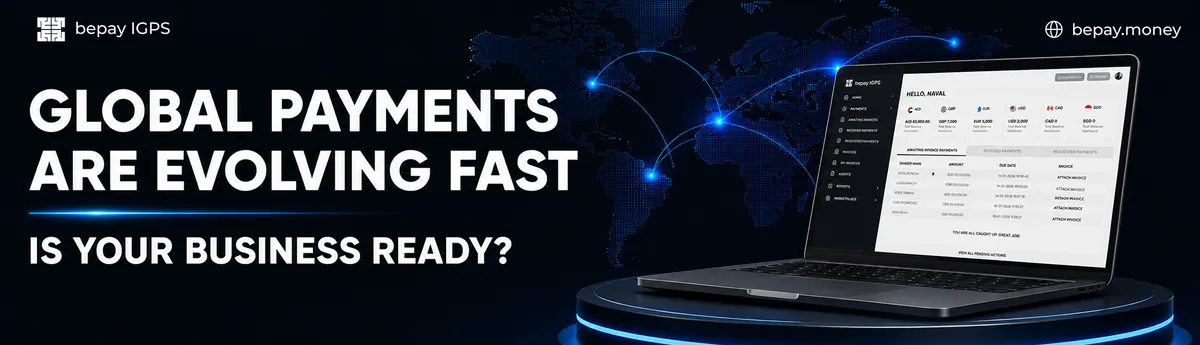

In today’s hyper-connected economy, cross-border payments are the lifeblood of business growth. Whether you are a software agency in Bangalore serving clients in New York, or an exporter shipping goods to the European Union, the ability to move money across borders efficiently is no longer a luxury, it is a competitive necessity.
Recent data suggests that B2B cross-border payment volumes are expected to surge to $124 trillion globally by 2028. Yet, despite this massive scale, many businesses remain trapped in a web of high fees, opaque exchange rates, and multi-day delays.
This guide explores the mechanics of international transactions, defines the essential industry terminology, and shows how bepay IGPS (Intelligent Global Payment System) is redefining the standard for modern trade.
What are International Payments?
A International payment occurs when the payer and the recipient are located in different countries. Unlike domestic transfers, these transactions involve multiple jurisdictions, different regulatory frameworks, and most importantly currency conversion.
Core Categories:
B2B (Business-to-Business): High-value commerce, such as paying international suppliers or receiving service fees from global clients.
B2C (Business-to-Consumer): Marketplace disbursements, such as Amazon or Shopify paying out to sellers.
C2B (Consumer-to-Business): An individual paying for a subscription, a university fee, or a luxury purchase from an overseas brand.
How International Payments Work: Behind the Scenes
Behind every "Send" button is a complex network of institutions working in tandem.
Initiation: The sender instructs their provider to transfer funds.
Routing via Hybrid Rails: Traditional payments use the SWIFT network, often passing through 1–3 Correspondent Banks. bepay IGPS utilizes Intelligent Smart Routing to find the fastest, most cost-effective path.
Compliance Screening: Every transaction undergoes rigorous AML (Anti-Money Laundering) and KYC (Know Your Customer) checks to meet international legal standards.
Currency Conversion (FX): The funds are converted from the sender’s currency (e.g., USD) to the recipient’s currency (e.g., INR).
Settlement: The final amount is credited to the recipient's account, and compliance documents like e-FIRA are generated.
The Cross-Border Glossary: Essential Terms for Businesses
To navigate the world of international finance, you must understand the "language of the trade":
SWIFT: The legacy messaging system used by banks. While reliable, it is often slow and carries "hidden" intermediary charges.
FX Markup: The difference between the real mid-market exchange rate and the rate a bank gives you. This is where most hidden costs reside.
vBAN (Virtual Bank Account Number): A digital account that allows you to collect payments locally in the US, UK, or EU as if you had a physical branch there.
e-FIRA (Electronic Foreign Inward Remittance Advice): A mandatory document in India that proves the funds received are from a legitimate export of goods or services.
Settlement Rails: The infrastructure (like ACH in the US, SEPA in Europe, or UPI in India) used to move money.
Mid-Market Rate: The "real" exchange rate is the midpoint between the buy and sell prices on the global currency market.
Correspondent Bank: A third-party bank that acts as a middleman to move money between two banks that don’t have a direct relationship.
Purpose Code: A specific code required by the RBI to categorize the nature of your foreign transaction (e.g., software exports vs. consultancy).
e-BRC (Electronic Bank Realization Certificate): A certificate issued by a bank confirming that the exporter has received payment against a specific export.
KYB (Know Your Business): The due diligence process used to verify the legal status and ownership of a business entity.
Intermediary Fees: Small charges deducted by middleman banks during a transfer, which often result in you receiving less than what was sent.
Real-Time Settlement: Modern infrastructure that allows funds to be credited almost instantly, bypassing the 3–5 day traditional wait.
PA-CB (Payment Aggregator-Cross Border): The specific RBI authorization that allows platforms to process international payments for Indian merchants.
Nostro Account: A bank account held by a domestic bank in a foreign country in that country’s currency to facilitate easy trade.
Incoterms: Standardized global rules that define who is responsible for costs and risks during international shipping.
FEMA (Foreign Exchange Management Act): The primary law in India that regulates all foreign exchange transactions to ensure they are legal and transparent.
The Challenges of Traditional Banking
Most businesses face four major friction points when using traditional banks:
High Costs: Between SWIFT fees and high FX markups, businesses can lose 3% to 7% of their total revenue.
Operational Delays: Traditional settlements take 3–5 business days, choking your company’s cash flow.
Compliance Burdens: Manually chasing banks for FIRA certificates and regulatory paperwork is a massive administrative drain.
Lack of Transparency: Not knowing exactly when the money will arrive or how much will be deducted by intermediary banks.
bepay IGPS: The Operating System for Borderless Business
bepay IGPS (Intelligent Global Payment System) was built to solve these inefficiencies. It bridges the gap between traditional banking and modern, intelligent payment rails.
Why Leading Businesses Choose bepay IGPS:
Ultra-Low Settlement Fees: We significantly reduce the heavy "handling fees" and SWIFT charges associated with traditional banks, allowing you to retain more of your hard-earned revenue.
Local Experience, Global Reach: Get virtual account details in the US, UK, Europe, China, and 100+ other countries. Your clients pay you via local methods, reducing friction and cost.
Near Real-Time Settlements: Why wait a week? With our optimized infrastructure, funds are often settled within 24 hours.
Automated Compliance: Receive your e-FIRA automatically upon settlement. No more manual follow-ups with bank relationship managers.
Bank-Grade Security: bepay is compliant with global standards like ISO 27001, SOC 2, and PCI DSS.
Modernizing Your Payments with bepay IGPS
Whether you are an Exporter looking to improve margins, an Agency receiving international invoices, or a Freelancer wanting a fair exchange rate, the choice of your payment partner defines your growth trajectory.
Don't let legacy banking systems hold your business back. Switch to a system designed for the speed of modern trade.
Ready to accept international payments with lower settlement fees and better rates?
[Get Started with bepay IGPS Now]
Follow our updates: Website | LinkedIn | Twitter | Instagram