
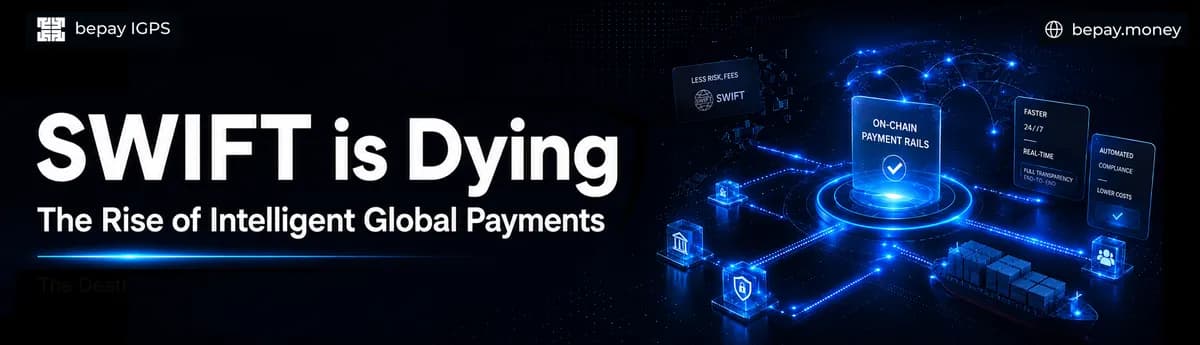

For more than half a century, the Society for Worldwide Interbank Financial Telecommunication better known as SWIFT has been the undisputed backbone of international trade. Established in 1973, it was designed for an era of telex machines, fax papers, and localized economies.
But it is now 2026. We live in a world of instant supply chains, real-time logistics tracking, and automated manufacturing. Yet, when an exporter ships a container of precision machinery or consumer goods across continents, they are forced to step into a financial time machine.
Suddenly, "instant" becomes 3 to 5 business days. Low overhead turns into hidden intermediary bank fees. Transparency vanishes into a black box of correspondent banking networks.
The verdict from global manufacturers and exporters is loud and clear: SWIFT is failing modern trade. Forward-thinking exporters are no longer willing to let legacy banking systems choke their cash flow. Instead, they are moving on-chain, migrating to Intelligent Global Payment Systems (IGPS) like bepay IGPS that bridge traditional banking with modern hybrid rails to settle international B2B transactions in near real-time.
Here is an in-depth breakdown of why SWIFT is facing its demise in global trade, and how moving on-chain is saving exporters up to 50% in transaction costs while unlocking critical liquidity.
The Legacy Problem: Why SWIFT is Killing Modern Manufacturing Margins
For a manufacturer or heavy exporter, cash flow isn't just a metric on a spreadsheet it is the lifeblood of operations. Money locked in transit is money that cannot be used to purchase raw materials, pay factory labor, or fund freight logistics.
SWIFT operates on a system called Correspondent Banking. When a buyer in the US pays an exporter in India, Europe, or South Africa, the money does not travel directly. It hops through multiple intermediary banks across different time zones.
This archaic structure introduces three critical friction points:
The 3-to-5 Day Settlement Blackout: Because every intermediary bank must manually reconcile its ledgers, cross-border payments routinely take days to settle. If a payment is sent on a Thursday afternoon, weekend closures and localized bank holidays can push settlement into the next week. For high-volume manufacturers operating on tight production schedules, these delays paralyze working capital.
The "Hidden Fee" Tax on Margins: This is notorious for its lack of pricing transparency. Every intermediary bank along the chain slices off a piece of the transaction ranging from $25 to $75 per hop plus arbitrary foreign exchange (FX) markups. By the time the wire hits the exporter’s account, the final amount rarely matches the invoice.
High Failure Rates and Administrative Nightmares: A single mismatched letter in an IBAN or a minor clerical error can cause a SWIFT wire to be rejected. Tracking a lost or stuck wire requires launching a trace request through the originating bank, a process that can take weeks, leaving both the buyer and seller in the dark.
The Reality of Modern Trade: In an era where a manufacturer can track a shipping container across the ocean via GPS in real-time, it is unacceptable that they cannot track the money paying for that container.
Enter the Era of On-Chain Trade: What is IGPS?
The systemic inefficiencies of old-world banking have triggered a paradigm shift. Exporters are migrating to Intelligent Global Payment Systems (IGPS).
Moving "on-chain" doesn't mean speculation or navigating volatile crypto markets. In the context of global enterprise trade, an IGPS leverages secure, compliant, blockchain rails and digital stablecoins alongside localized banking networks.
By utilizing decentralized, programmable ledgers, an IGPS can instantly verify, route, and settle cross-border transactions without requiring a daisy-chain of correspondent banks. It replaces legacy messaging systems with instant, atomic settlement.
Why Exporters are Joining bepay IGPS
For global exporters, manufacturers, and trade merchants, joining bepay IGPS isn't just about switching to a new payment provider it is about completely optimizing your business's financial health. Traditional banking systems slow down your operations and eat into your profits.
Here are the primary reasons why modern exporters are leaving legacy systems behind and joining the bepay IGPS network:
1. Eliminate Cash Flow Bottlenecks with Near Real-Time Settlement
In traditional trade finance, waiting days for an international wire to clear is standard. For manufacturers, this locks up critical working capital needed for raw materials, factory labor, and supply chains. bepay IGPS utilizes modern, hybrid on-chain routing to settle global payments in near real-time, ensuring your money is in your hands almost instantly.
2. Save Maximum on International Transaction Costs
Legacy banking relies on multiple intermediary banks taking a cut of your money via hidden handling fees and high foreign exchange markups. bepay IGPS uses an intelligent smart-routing engine to cut out these middleman banks, reducing your total cross-border settlement costs by up to 50%. You keep your hard-earned margins instead of funding banking inefficiencies.
3. Offer a "Local" Payment Experience to Global Buyers
It is always easier for international buyers to pay in their local currency using domestic banking methods. bepay IGPS provides you with multi-currency virtual bank accounts in key economic zones like the US, UK, European Union, UAE, China, India, and Africa. Your buyers pay locally in USD, EUR, GBP, AED, CNY, or ZAR, and you collect the funds seamlessly without cross-border friction or forced, expensive bank conversions.
4. Get Automatic Compliance Documents (Instant e-FIRA)
One of the biggest administrative headaches for exporters is proving to tax authorities and central banks that their foreign earnings are legitimate. Usually, getting an FIR certificate takes days of manual bank follow-ups. bepay IGPS automates this completely by generating instant e-FIRA (Electronic Foreign Inward Remittance Advice) and e-BRC (Electronic Bank Realisation Certificate) documents right upon settlement, keeping your business 100% audit-ready automatically.
5. Quick and Frictionless KYB Onboarding
Traditional international business bank accounts take weeks of paperwork, interviews, and compliance checks just to get approved. bepay IGPS is built for modern digital commerce. With our streamlined Quick KYB Approval process, your business can get verified and set up with global payment collection rails in record time, preventing any operational delays.
SWIFT vs. bepay IGPS: A Quick Comparison
Settlement Speed: SWIFT takes 3 to 5 business days, whereas bepay IGPS offers near real-time settlement.
Fee Structure: SWIFT involves high, unpredictable intermediary fees, while bepay IGPS uses low-cost, transparent flat rates.
Tracking & Visibility: SWIFT is opaque and requires manual bank traces, while bepay IGPS is 100% transparent via a digital dashboard.
Compliance Documents: SWIFT requires manual application taking days or weeks, while bepay IGPS offers instant e-FIRA.
Availability: SWIFT is restricted to banking hours and weekends, while bepay IGPS operates 24/7/365 uninterrupted.
Conclusion: The Horizon of Global Trade is On-Chain
The demise of SWIFT in global trade is not an overnight revolution; it is an evolution dictated by necessity. As global supply chains tighten and competitive margins shrink, the luxury of waiting days for capital to clear is gone. Manufacturers and exporters can no longer afford to fund an outdated banking monopoly.
By shifting cross-border trade payments to on-chain hybrid rails through bepay IGPS, forward-looking enterprises are capturing a major competitive advantage. They are securing instant liquidity, slashing overhead costs by half, automating compliance, and presenting an elite, localized payment experience to their global buyers.
The era of legacy cross-border delays is over. Welcome to the future of friction-free, borderless commerce.
[Get Started with bepay IGPS Now]
Go Global Without Complexity.
Follow our updates: Website | LinkedIn | Twitter | Instagram