

We Can Message Anyone Instantly. Why Is Sending Money Still So Complicated?
Sending a message today is effortless.
You open an app, search for a contact, type a few words, and hit send.
The message reaches the other side of the world in seconds.
But when it comes to moving money, the experience often feels surprisingly complicated.
In traditional finance, users are asked to navigate account numbers, IFSC codes, IBANs, SWIFT details, and beneficiary information.
In crypto, the experience isn't always much simpler. Users often deal with long wallet addresses, multiple blockchain networks, token compatibility issues, and the constant fear of sending funds to the wrong address.
Different technologies. Similar friction.
Whether you're making a bank transfer or sending crypto, the process frequently requires users to manage information that was designed for systems not for people.
The challenge isn't that traditional finance is broken or that crypto is too complex.
The challenge is that neither was originally built around a simple, universal payment identity.
As digital payments continue to evolve, users increasingly expect money to move as easily as communication. They want to send funds to a person, not to a string of numbers or a 42-character wallet address.
The Hidden Friction of Traditional Payments
Most people don't think about payment infrastructure until it gets in their way.
It happens when:
A friend pays the restaurant bill and everyone struggles to settle their share.
A freelancer waits days for an international payment to clear.
Parents need to send emergency funds to a child studying abroad.
Family members lose money due to high remittance fees.
Traditional financial systems were built decades ago for a world that looked very different from today's digital economy.
Modern life is global, mobile, and always connected.
Money should move the same way.
Yet international transfers often pass through multiple intermediaries before reaching the recipient. Each institution adds time, complexity, and cost.
The result is a payment experience that feels outdated in an age of instant everything.
What Peer-to-Peer Payments Were Always Meant to Be
The original promise of digital payments wasn't just about going cashless.
It was about removing friction.
P2P payments bring that promise to life by allowing individuals to transfer value directly to one another without relying on layers of traditional infrastructure.
Instead of navigating complex banking processes, users simply choose who they want to pay and send funds instantly.
The technology behind the transaction becomes invisible.
The experience becomes effortless.
That's exactly how financial technology should work.
Sending Crypto Through a Phone Number? Yes, Really.
One of the biggest challenges preventing mainstream crypto adoption has always been complexity.
Most crypto wallets require users to copy and paste long wallet addresses filled with random letters and numbers.
For new users, that process can feel intimidating.
For experienced users, it's still inconvenient.
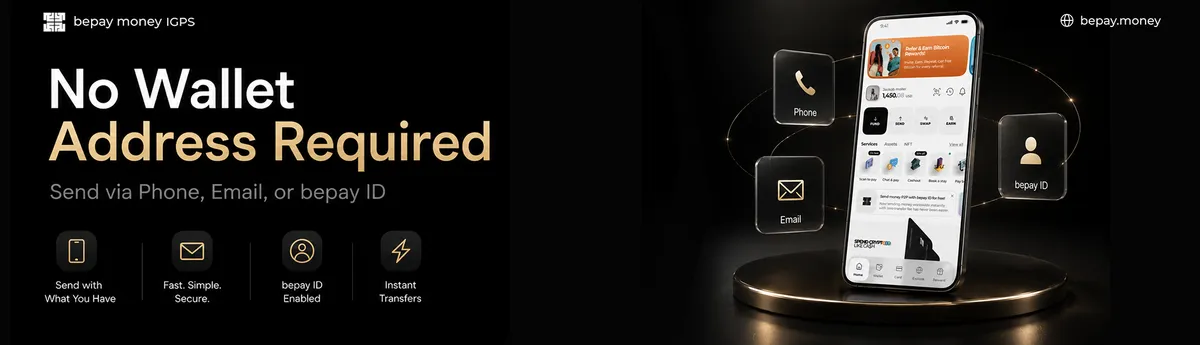
bepay money simplifies this entirely.
Imagine owing your friend ₹2,000 after dinner.
Instead of asking for bank details or a wallet address, you simply select their phone number and send the payment.
Within moments, the transaction is complete.
No lengthy forms.
No confusion.
No unnecessary steps.
Just a simple transfer between two people.
The way it should be.
Email-Based Payments Bring Familiarity to Crypto
Email transformed communication because it gave people a universal digital identity.
Today, almost everyone has an email address.
bepay money extends that familiarity into payments.
Need to pay a freelancer in another country?
Want to send funds to a family member?
Simply use their email address.
The experience feels intuitive because it mirrors behaviors people already understand.
Technology adoption happens faster when people don't need to learn entirely new habits.
That's why simplifying crypto payments matters.
The easier the experience, the more useful the technology becomes.
Your bepay ID: A Simpler Way to Receive Payments
Social media platforms made usernames popular because they're easy to remember and easy to share.
bepay money applies the same concept to financial transactions.
Every user receives a unique bepay ID.
Instead of sharing wallet addresses or banking information, users can simply share their bepay ID and receive funds instantly.
It's a small innovation that creates a dramatically better user experience.
Because convenience isn't about adding more features.
It's about removing unnecessary steps.
A Truly Borderless Way to Move Money
The internet created a world where people can work, communicate, and collaborate globally.
Yet money often remains restricted by national borders.
Traditional international payments frequently involve:
Delayed settlements
Multiple intermediaries
High transfer costs
Currency conversion fees
For millions of people, these inefficiencies create real financial barriers.
Blockchain technology changes the equation.
By enabling value to move across networks rather than through multiple institutions, transactions become faster, more transparent, and more accessible.
Whether you're supporting family overseas, paying a global contractor, or sending emergency funds internationally, the goal remains the same:
Move money as freely as information moves online.
More Than Payments: Building a Complete Financial Ecosystem
P2P transfers are only one part of the broader bepay money vision.
The platform combines multiple financial services into a single Web3-powered ecosystem, including:
Self-custody crypto wallets
Virtual crypto debit cards
Swiss IBAN accounts
QR code payments
Cross-border transfers
Tokenized investment opportunities
Staking and earning solutions
Everyday crypto spending utilities
Rather than forcing users to manage multiple disconnected financial apps, bepay brings everything together in one seamless experience.
Because the future of finance isn't fragmented.
It's integrated.
The Future of Money Is Human-Centric
For decades, financial systems have been built around institutions.
The next generation of finance is being built around people.
Instead of asking users to adapt to outdated infrastructure, modern financial platforms are adapting to the way people naturally live, work, and interact.
That's why the future of payments won't be defined by account numbers or banking hours.
It will be defined by simplicity.
A phone number.
An email address.
A username.
A QR code.
The easiest technologies often become the most transformative because they remove complexity rather than add it.
And when sending money becomes as easy as sending a text, financial freedom becomes accessible to everyone.
Final Thoughts
Money should move at the speed of modern life.
Whether you're splitting a dinner bill, paying a freelancer, helping family abroad, or transferring funds across continents, the process shouldn't be slowed down by outdated systems.
With bepay money's Peer-to-Peer transaction capabilities, users can send crypto instantly through phone numbers, email addresses, QR codes, or bepay IDs—creating a payment experience that's simple, secure, and truly global.
Because in a connected world, payments should feel just as effortless as communication.
Download App: bepay money on Google Play Store
Connect with us: Website | LinkedIn | Twitter | Instagram